

In the Centre for Ecology and Biodiversity, we examine the flow of energy and elements within marine ecosystems to uncover how they shape the composition, structure, and functioning of these environments. Our research covers a broad spectrum, including the dynamics of food webs and trophic interactions, and the impact of environmental changes on ecosystems. We also investigate the population dynamics of key species, examining their life history, growth patterns, mortality rates, and recruitment processes.
Our work includes studying carbon and nutrient cycling, focusing on the fundamental processes that drive life in both the water column and seabed. We employ cutting-edge techniques such as field sampling, laboratory experiments, statistical and dynamic modeling, and advanced quantitative methods to conduct our research.
Through our efforts, we aim to unravel the complexities of marine ecosystems and enhance our understanding of their resilience to various threats.
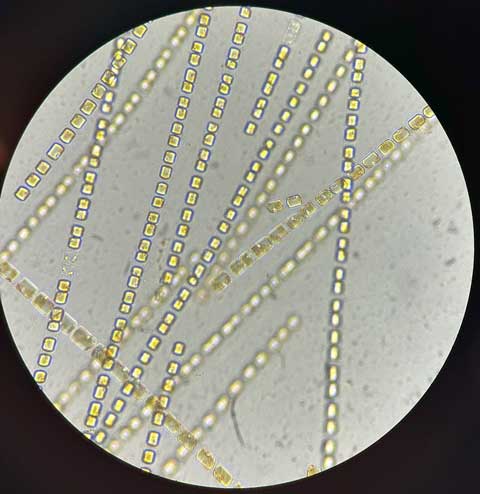
Ocean biogeochemistry allows us to understand how nutrients and carbon are utilised within marine ecosystems, forming the building blocks of marine food webs: phytoplankton. Phytoplankton – microscopic algae thriving in marine waters – influence the flow of energy and elements in marine ecosystems.
In the Centre for Ecology and Biodiversity, our research focuses on better understanding the mechanics of these essential processes, and how they are altered by anthropogenic threats
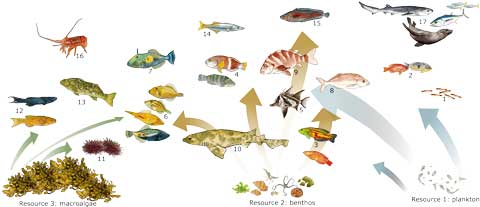
Marine food webs are complex and driven by specific dynamics at different trophic levels.
In the Centre for Ecology and Biodiversity, our research aims to understand how changing traits, such as body size, influence processes that scale up from individuals to populations and whole ecosystems.
Our research also focuses on trophic dynamics in the marine environment, such as prey distribution and abundance, energy transfer and growth potential, feeding ecology, and how the environment and human impacts affect these processes.