

Banner image credit: Philip Samartzis
The ARC-funded Discovery Project, “Creative Antarctica: Australian Artists and Writers in the Far South” is focused on understanding the experiences of professional artists and writers in the Antarctic region. The project aims to make the rich history of Australian artists' and writers' engagement with Antarctica visible and to generate new interdisciplinary knowledge of creative responses to the South Polar region.
“Creative Antarctica” includes the first comprehensive history and analysis of the Antarctic stories, sounds, and images produced by Australian artists and writers. The research is conducted by a large multi-institutional and international team, led by Prof. Elizabeth Leane, and aims to maximise the outcomes and benefits of residencies offered by national programs, tour operators and other organisations.
At a time when Antarctica's future is threatened by warming temperatures and geopolitical tensions, the project provides significant benefits in the form of broader and deeper public engagement with the ice continent.
The project team includes a PhD position and the candidate will complement the national focus of the team by examining and comparing the aims, structures and outcomes of Antarctic residency schemes globally.
News and events
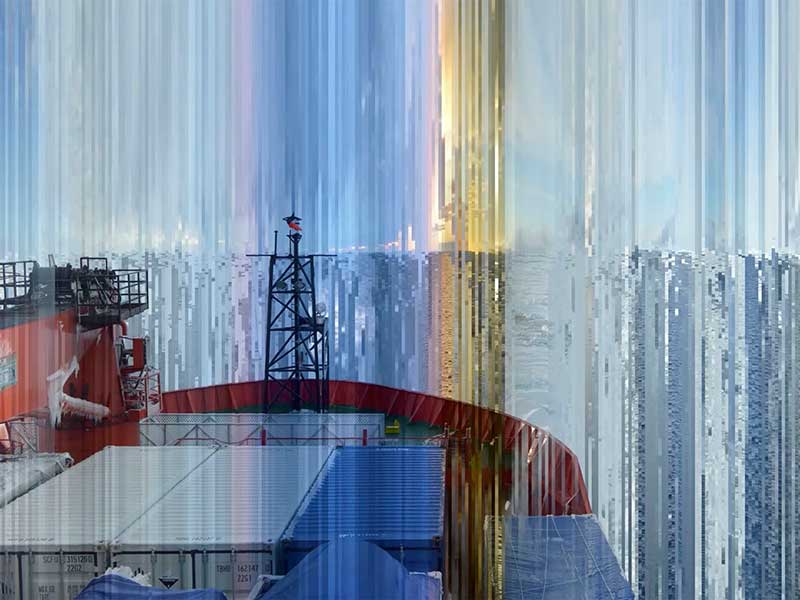
Creative Antarctica team members Philip Samartzis, Martin Walch and Sean Williams have created the artwork Icebreak.
Icebreaker is a 19-minute, immersive audio-visual installation that traces the charged atmospheres, fractured rhythms, and unstable surfaces encountered aboard the RSV Aurora Australis as it journeys from Mawson Station across the Southern Ocean to Hobart, Tasmania.
Developed through the fieldwork and collaborative research of sound artist Philip Samartzis, visual artist Martin Walch, and writer/composer Sean Williams, Icebreaker draws on field recordings, digital imaging and animation, and composed sound to render the volatile seascapes and navigational uncertainties of polar transit. Using timelapse photography captured at 150-second intervals, the work compresses a multi-day voyage into a restless, shimmering flow of image and sound—documenting shifting light, violent weather systems, and the relentless motion of an icebreaking passage.
The ship emerges as a paradoxical space: a site of containment surrounded by vastness, of structure amid instability. Onboard life unfolds through procedural routines and constant vigilance, revealing how control and adaptation coexist in conditions of extremity. Icebreaker evokes not only the physical pressures of navigating polar seas but also the psychological intensity of such journeys—where time disorients, and every creak, jolt, and echo signals the fragile negotiation between vessel and environment.
Icebreaker is produced with the support of the Australian Antarctic Arts Fellowship program, which hosted Samartzis in 2010 and 2016, Walch in 2017/2018, and Williams in 2017.
Icebreaker is created within the framework of the ARC-funded Discovery Project, “Creative Antarctica: Australian Artists and Writers in the Far South”.
Icebreaker is an invitation to drift within a world of rupture, inertia, and deep listening.
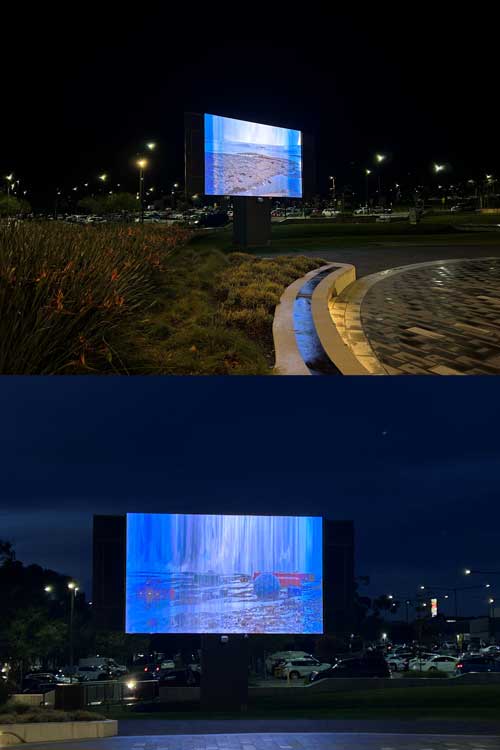
The Magnetic Quiet Zone (TMQZ) installation by Philip Samartzis, Martin Walch and Sean Williams has been programmed into the Bunjil Place (Victoria) outdoor screen during June 2025. The work features as part of Bunjil Place’s 2025 Art After Dark program.
TMQZ is an immersive, 35-minute audio-visual installation that explores the frozen sounds and stagnant silences, the strange atmospherics, and the dynamic forces shaping the margins of our planet.
Through the lens of the Antarctic landscape, it brings into focus the uncanniness of a place where time and space fold into a perpetual present.
The work has previously been featured in the Canberra International Music Festival and the Strange Weather exhibition.
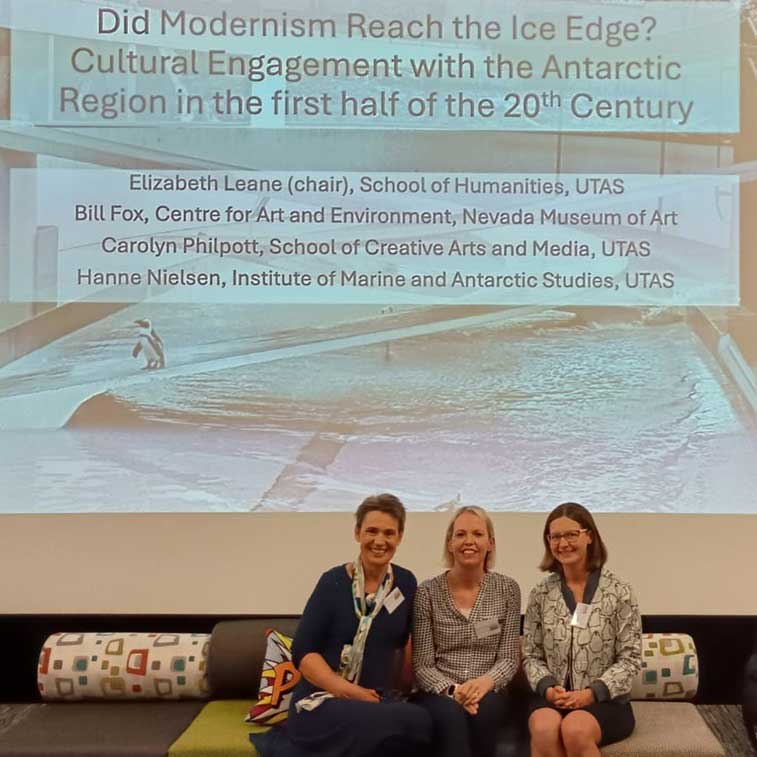
The 2024 Australasian Modernist Studies Network conference “Modernism and modernity at the edge” took place 11 – 13 December 2024 at the University of Tasmania.
On 11 December, Creative Antarctica team members Professor Elizabeth Leane, Dr Hanne Nielsen and Dr Carolyn Philpott (University of Tasmania), and Bill Fox (Nevada Museum Center for Art + Environment) presented the panel discussion “Did Modernism Reach the Ice Edge? Cultural Engagement with the Antarctic Region in the first half of the 20th Century”.
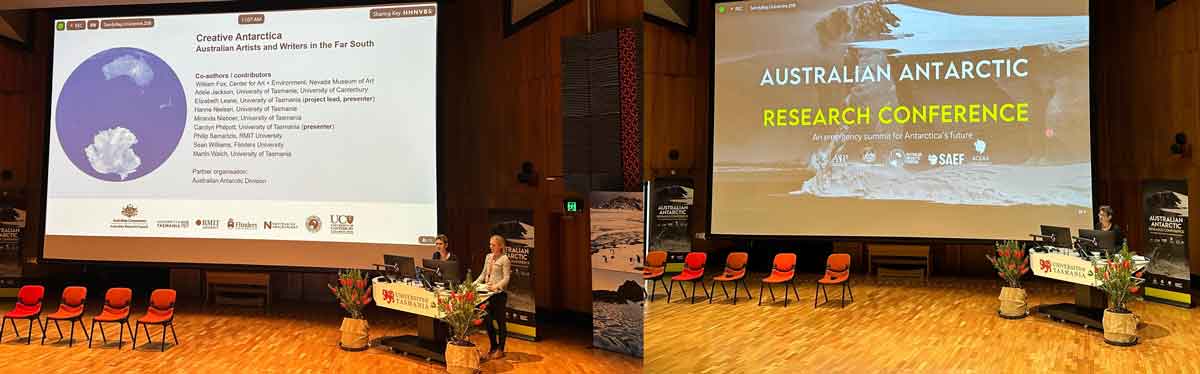
Creative Antarctica team members Professor Elizabeth Leane and Dr Carolyn Philpott delivered a paper about the Creative Antarctica project at the 2024 Australian Antarctic Research Conference. AARC was hosted at UTAS in the week of 18 November and included workshops, networking and social events.
The conference brought together Australia’s polar research community for the first national meeting in many years. It sought to cover the full breadth of Antarctic, Southern Ocean and sub-Antarctic research. Contributions were welcomed from all relevant disciplines, including glaciology, oceanography, atmospheric science, biology, geophysics, biogeochemistry, human impacts, humanities, law, arts and social sciences, as well as new technologies and their application.
The Magnetic Quiet Zone installation by Philip Samartzis, Martin Walch and Sean Williams has been programmed into the 2025 Canberra International Music Festival, continuing a growing series of showings.
TMQZ will feature as part of MOSSO: music in motion, on 3 May 2025 from 10 am to 6 pm. The event is a dynamic, all-day celebration of contemporary music, moving images, and spatial sound, showcasing Australia’s top composers, sound artists, new media artists, and performers in a stunning array of multimedia experiences. Find out more at MOSSO: music in motion.
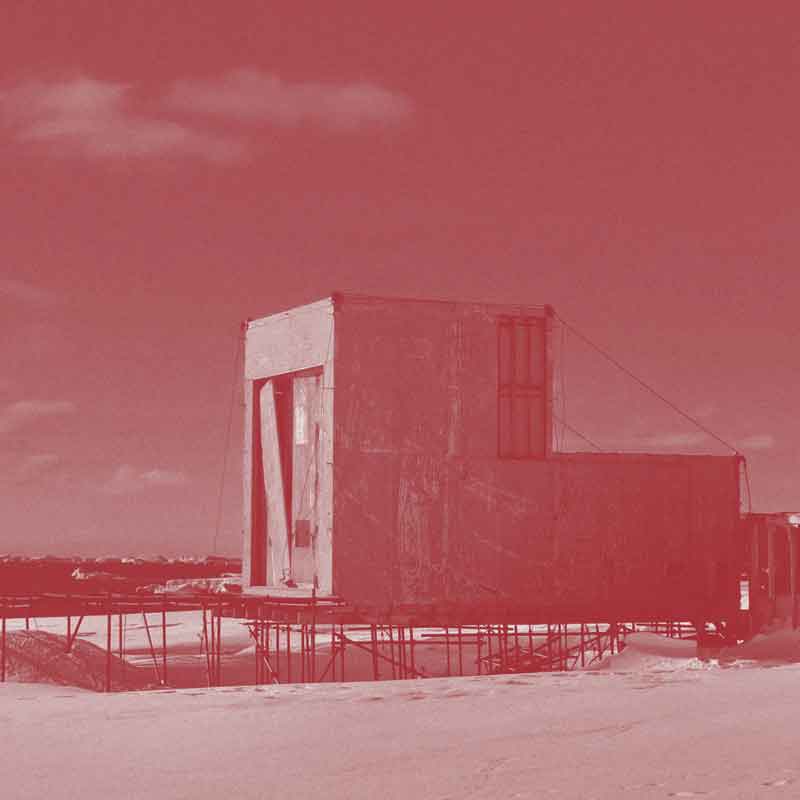
Creative Antarctica team member Professor Philip Samartzis has a new release on Brisbane label Room40 titled “Air Pressure” available on 6 December 2024. “Air Pressure” is a collaborative project with Berlin light and sound artist Michael Vorfeld and is based on recordings Philip made of dynamic weather events in Antarctica. Read more about the album below:
“Air Pressure” comprises field recordings made in Eastern Antarctica that highlight the impacts of extreme climate and weather on a variety of research stations and field huts and their associated infrastructure. These recordings serve as the foundation for a series of improvised musical responses using percussion and self-designed string instruments in combination with extended techniques that aim to intertwine the sound of materials, instruments, and environment.
“Air Pressure” reflects the instability of the south polar region, characterized by dynamic weather that generates a wide range of auditory experiences—from stagnant silences to sharp tonal contrasts. These mutable conditions are mirrored in tactile instrumental performances, which respond to the patterns, resonances, ruptures and chaos inherent in the Antarctic landscape and its constructed spaces.
“Air Pressure” celebrates the indeterminate forces and strange atmospherics operating at the margins of our planet within the framework of contemporary haptic performance. The dissonance arising from these tensions invites listeners to experience a unique form of sensorial engagement shaped by both tangible and spectral realities. This project thus underscores the complex interplay between powerful natural forces and human-made structures and objects set within one of the world’s most abrasive environments.
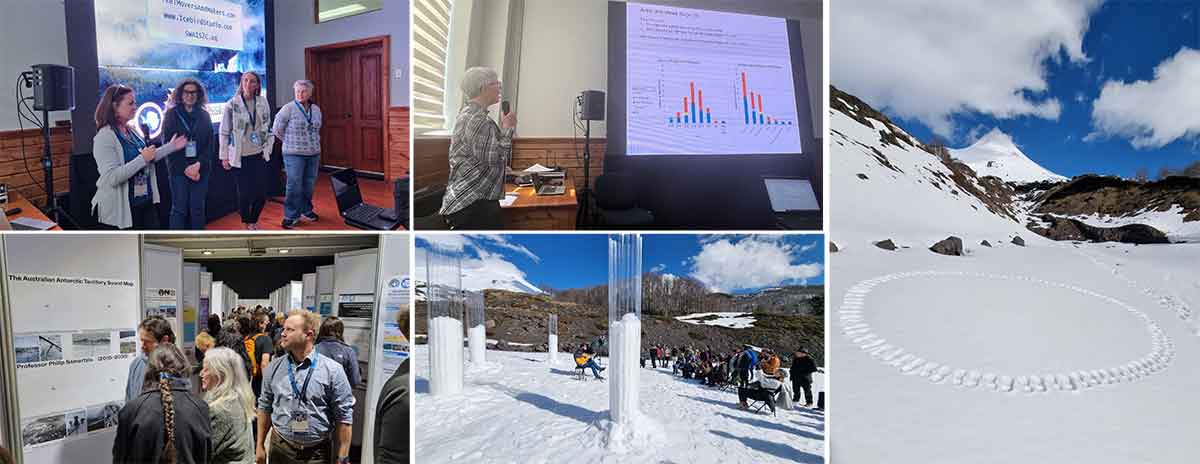
Some of the Creative Antarctica team recently visited Pucón Chile for the biennial SCAR Antarctic Research conference.
Adele Jackson led an “Antarctica and the Arts” session, with Elle Leane and Carolyn Philpott (in absentia) as co-convenors. The session hosted sixteen papers from a diverse range of Antarctic artists and scholars from across the world. Together Elle and Adele presented a paper on the preliminary findings from the Creative Antarctica project, and Philip Samartzis presented a poster on his “The Australian Antarctic Territory Sound Map” 2010-2030 project.
The opportunity to experience a music concert on the slopes of Villarrica, Chile’s most active volcano, could not be missed. Adele was inspired to leave an artistic trace in view of the summit.
The Magnetic Quiet Zone installation by Creative Antarctica team members Philip Samartzis, Martin Walch and Sean Williams is featured in the upcoming forumprojects gallery. The gallery is located in Sydney at the dockside commercial 2 space next to wharf 4/5. The Magnetic Quiet Zone will be presented in the space from 6 November to 20 November (open Tuesday to Saturday). Check out the promotional video and read more about forumprojects below.
The opening of The Magnetic Quiet Zone is at 5:30pm on Wednesday November 6 at the forumprojects gallery, wharf 4/5 dockside, 15 Hickson road, Dawes Point, Walsh Bay arts precinct. RSVP to attend by email: forumprojectsgallery@gmail.com or insta: @forumprojects or @maxlyandvert.
Forumprojects is a new organisation, as well as a unique gallery that is dedicated to immersive sound and video art. The organisation seeks to integrate artistic practices with a broader range of creative industries. By extending the work of artists towards these collaborations, we hope to creatively progress pathways to innovation. It is a key aim of forumprojects to infuse new ideas and a more integrated relationship with art, into our broader community.
With support from Create NSW, forumprojects is launching forumprojects gallery, presenting the first season of six leading video and sound artists, on 23 October. The season will run through to 25 January and is part of the Sydney Festival.
Season 1
- John Gillies 23 Oct – 5 Nov
- Philip Samartzis 6 Nov – 20 Nov
- Laura Turner 21 Nov – 5 Dec
- Max Lyandvert 7 Dec – 21 Dec
- Oren Ambarchi 23 Dec – 7 Jan
- Angelica Mesiti 9 Jan – 25 Jan
The Creative Antarctica team has contributed in various ways to the 2024 Hobartica and broader Beaker Street Festival events. Hobartica is described as “a meeting place for international cultures and polar traditions”, and includes roving scientist events as well as sauna and plunge experiences.
Professor Elizabeth Leane is one of the Roving Scientists @ Hobartica, stationed throughout the McHenry Distillery Antarctic Lounge and Observatory for a chat during the week beginning 5 August.
You can also see Elle talking about the Antarctic Women’s Network and creative artists in Antarctica for the Beaker Street Festival. And Creative Antarctica is featured in this article about Hobartica in The Guardian.
Elle also participated in the “Through Our Eyes” exhibition at TMAG, curated by Dr Miranda Nieboer, another Creative Antarctica team member.
The exhibition brings the southernmost continent, commonly understood as far away and isolated, closer to a large audience through an imaginative multimedia installation focused on women and their personal and professional relationship with Antarctica.
Read more about “Through Our Eyes” in this ABC article.
Miranda and Dr Hanne Nielsen also both spoke engagingly for the “Antarctic Stories at Mawson’s Hut” event at the Replica Museum.
Professor Philip Samartzis contributed to the Beaker Street Festival event “Floe”. Held at TMAG’s Watergate Welcome Garden, this event celebrates the natural science and cultural heritage of Antarctica. Select days of this week-long event include Philip’s soundtrack to add “an immersive element to the Antarctic projections”.
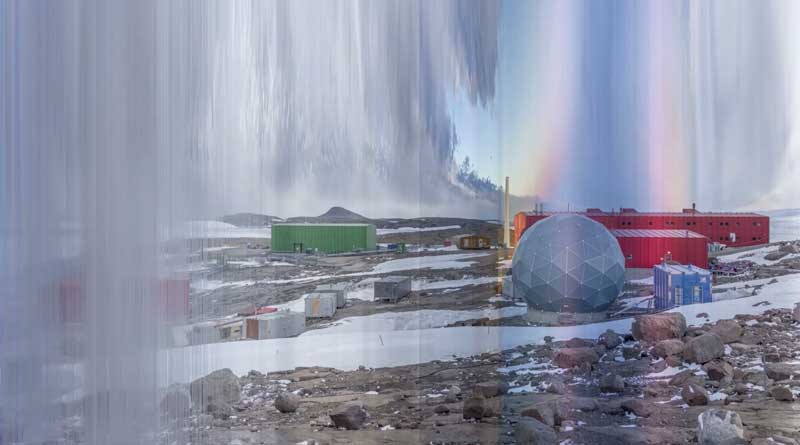
The 2024 “Strange Weather” exhibition presented by the University of the Sunshine Coast features an outcome of the Creative Antarctica project: The Magnetic Quiet Zone. The Magnetic Quiet Zone is a collaboration between Philip Samartzis, Martin Walch and Sean Williams culminating in a 35-minute audio-visual installation exploring the frozen sounds and stagnant silences, the strange atmospherics and dynamic forces operating at the margins of our planet.
The overall exhibition “Strange Weather” brings together artworks that broadly consider how our contemporary understanding of the environment and our place within it is mediated by technology. Here strange weather is a metaphor for ecological, geopolitical, technological and economic fragmentation. The artists in this exhibition use photography, moving images, sound, data, mapping and weather monitoring technologies, among others, to explore aspects of atmospheric strangeness that shape our understanding and experience.
The exhibition runs 25 May – 3 August 2024.
Professor Elizabeth Leane spoke with Alex and Lindsay at the “EcoCAST” podcast run by the Association for the Study of Literature and Environment (ASLE).
The discussion ranged across many topics, including science fiction, Antarctic tourism and the politics of silence in the ice continent.
Check out the episode (Mis)Conceptions of Antarctica with Dr. Leane!
Professor Elizabeth Leane talked to Clark Marchese about Antarctic literature on the podcast “South Pole: Exploring Antarctica”.
This episode of “South Pole” enriches understanding of Antarctica through the lens of literature and inspires consideration of how the global community perceives and influences remote and vulnerable regions.
Listen to Antarctic Literature and Public Perception.

The “Growlers, Bergy Bits and Behemoths” program of events surrounding ANTARCTICA the Opera in concert in Hobart ran from 17 April 2024 to 19 April 2024 and showcased UTAS’s HASS-related Antarctica research, including the Creative Antarctica project. The program’s talks ranged in topic from the creative potential of Antarctica research to ethical and sustainable tourism in the South. With something for everyone, these public events offered the opportunity to engage with Antarctica research and researchers from various perspectives.
Several of the events featured Creative Antarctica team members. Professor Philip Samartzis (RMIT) and Dr Sean Williams (Flinders) travelled to Hobart for the events and ran the audio/video installation “Magnetic Quiet Zone” with Dr Martin Walch (CAM, UTAS). Dr Carolyn Philpott (CAM, UTAS) also facilitated the session “Uncharted Soundscapes”, which featured ANTARCTICA creator Mary Finsterer.
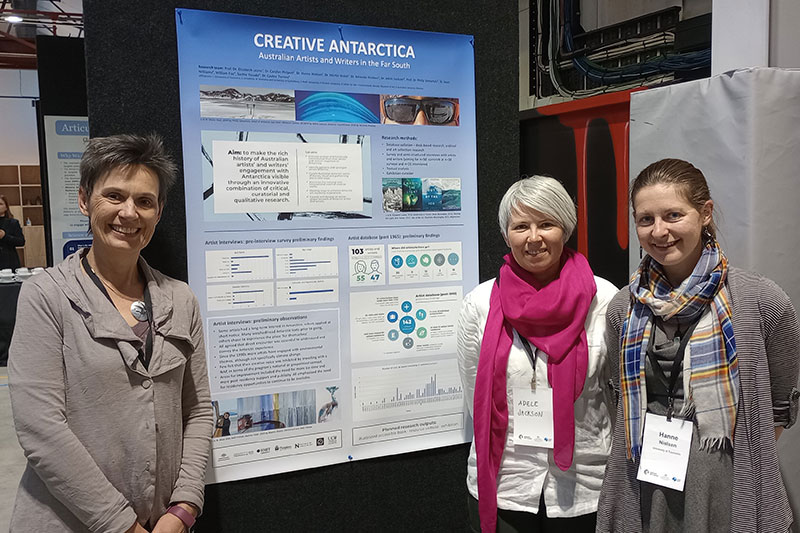
Three members of the Creative Antarctica team presented the team’s findings to date at the New Zealand Australia Antarctic Science Conference (NZAASC) on 26 July 2023.
The presentation took the form of a poster, and was successfully delivered by Professor Elizabeth Leane, Dr Adele Jackson, and Dr Hanne Nielsen (pictured left to right). The poster included initial findings from surveys and interviews with artists and writers, as well as data from the project’s artist database.
Following this conference appearance, the team looks ahead to their Melbourne Symposium (31 August 2023), which is a public event offering the opportunity for broad engagement with Antarctica
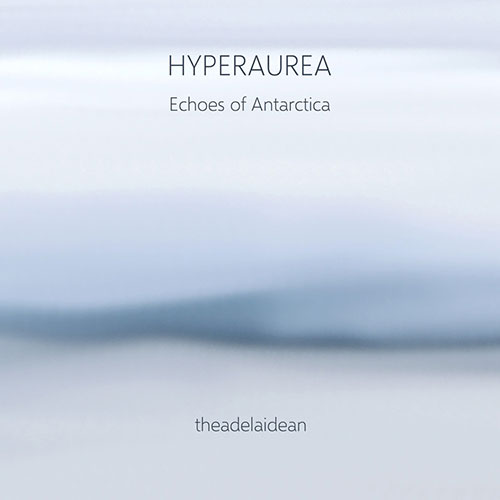
Dr Sean Williams, a member of the University of Tasmania’s “Creative Antarctica” project, has released an album of ambient music inspired by the frozen continent.
Writer and musician Dr Sean Williams has been fascinated with Antarctica ever since he was a kid. So, when he finally got the opportunity to visit Casey Station for an artistic fellowship in 2017, he was thrilled.
But thanks to an unfortunate series of bureaucratic delays, what should have been two months in Antarctica turned into just nine days.
Nonetheless, Sean was determined to make the most of the opportunity and he can’t wait to go back some day.
“I got so much out of those nine days. I did a lot of writing while I was there and I’m still mining those experiences and everything I learned.”
A Senior Lecturer in the College of Humanities, Arts and Social Sciences at South Australia’s Flinders University, Sean not only teaches creative writing, but is also a prolific and award-winning writer of speculative fiction novels and short stories.
His other passion is experimental music and, while he originally intended to focus solely on writing in response to his Antarctic residency, the soundscape of the place inspired him to turn to music as well.
“I did write a lot about the experience. Within the first couple of days of returning home to Adelaide I wrote a piece of flash fiction, which was published not long after, as well as four or five short stories, some poetry and non-fiction.
“But what was missing, for me, was the wordless response. I can’t draw, so that wasn’t an option, but music I can do!
“I found the sounds down there absolutely fascinating: people inside the station, weather sounds, all of it. Everywhere I went, there was interesting sounds or music happening and it inspired me to think about an aural response in some form.”
The resulting album, Hyperaurea – Echoes of Antarctica, is almost four hours of ambient music that evokes the vastness and isolation of Antarctica.
“One track is inspired by the hut where people go to pursue hobbies in their spare time, and I’ve used the sounds of my artist friend Thom Buchanan at work to evoke the way people are so industrious down there.”
Sean is also a Chief Investigator with the University of Tasmania’s Creative Antarctica project, which is investigating the importance of the work done by artists who complete residencies in Antarctica, compiling a comprehensive history and analysis of the Antarctic stories, sounds, and images produced by Australian artists and writers.
As an academic, an artist, and the recipient of a residency, he is a firm believer in the value such creative perspectives can bring to the greater public understanding of Antarctica and related issues.
“Humans understand things through creative responses as well as through numbers and data. They want to know things on another level, feel intimately connected to something.
“It’s the difference between a Wikipedia page about someone and a memoir. Artists are trying to write the life story of Antarctica through humanity’s eyes.
Years after his artistic fellowship, Sean is still creating written work based on his time in Antarctica. And he plans to go back as soon as he can. As those who have been south like to say: he has ice in his veins now.
“And with Antarctica being under concerted attack by climate change, it makes it all the more important that we understand it while we still can, otherwise it will be gone and we will only have the numbers left.”
University of Tasmania researchers are heading to an international conference in Portugal in June to highlight the importance of Antarctic-inspired art.
For most of us, the only way we can experience Antarctica is through the eyes of others. So, representations of the frozen continent through various artforms play a crucial role in the way we see and understand it, culturally and scientifically.
A number of countries, including Australia, run artist-in-residence-style programs, sending artists and writers to Antarctica to create work inspired by their experience.
The University of Tasmania’s “Creative Antarctica” project is investigating the importance of this creative perspective in our collective consciousness, compiling a comprehensive history and analysis of the Antarctic stories, sounds, and images produced by Australian artists and writers.
A team from the project is preparing to give a talk in Portugal about their research, with lead researcher and Professor of Antarctic Studies, Professor Elizabeth Leane saying artists play a vital role in efforts to help people engage with Antarctica, including the science done there.
“There is agreement these days that there are a lot of problems we can’t solve with just science. When it comes to issues like climate change, we all need to work together, and that means uniting people in ways that only the arts can do.”
The 2023 SCAR SC-HASS conference is being held in Lisbon, Portugal from June 22-24, with the theme “The Antarctic for a Better World.” The Standing Committee on the Humanities and Social Sciences (SC-HASS) is part of the Scientific Committee on Antarctic Research (SCAR).
Elizabeth is one of the founders of the SC-HASS, which leads and coordinates Antarctic research from a Humanities and Social Sciences perspective, and provides advice on Antarctic-related issues that require a human-centric or multidisciplinary approach.
Also travelling to the conference are fellow project members: Dr Adele Jackson, a postdoctoral researcher on the project; Dr Hanne Nielsen, from the Institute for Marine and Antarctic Studies; and William Fox, Director of the Center for Art + Environment in Nevada.
Jackson and Fox are speakers in two round-table discussions at the conference with the themes of “Curating Antarctica” and “Situating Antarctic Art.”
The Creative Antarctica project is funded by the Australian Research Council. Elizabeth said its findings were a vital part of ongoing efforts to create deeper, broader public engagement with Antarctica and the issues surrounding it.
“Very few people actually go there, nobody is born there and, more than anywhere else in the world, most people only know it through stories, art, and texts of various kinds,” she said.
“So it’s important to know how that works, what messages are being conveyed, explicitly or implicitly. Because, ultimately, it’s not scientists but all of society who are the ones who make decisions about Antarctica.
“Who to send there, who should govern it and so forth, these are all decisions that are made on the basis of what it means to us as a society.”
Dutch artist Esther Kokmeijer visited UTAS and presented “Vapour, Liquid, Solid” at IMAS on 26 April 2023. Esther’s work engages with water, ice and the Antarctic region, and Esther is also the founder of a new art-science journal, Anktarktikos.
Esther’s bio: Esther is an artist and explorer residing in Rotterdam and working around the globe. In her work as a visual artist, she mainly focuses on the “Global Commons” – the globally shared natural resources of the earth: the oceans, the atmosphere, the universe and Antarctica in particular. The theme of water in all its manifestations, such as liquid “water”, gaseous “vapour” and solid “ice”, has played a major role in her works for several years.
Her work has been exhibited and published worldwide. For various projects, she has visited 84 countries. In addition to being founder of Antarktikos, an annual printed journal that is solely dedicated to Antarctica and brings together art and science, she is co-founder of Cosmic Water Foundation and part of the art collective If Paradise Is Half As Nice.
Date and time: Thu 31st Aug 2023, 9:15 am - 1:00 pm AEST
Place: Kaleide Theatre at 360 Swanston St, Melbourne VIC
Link for further info and tickets: https://events.humanitix.com/creative-antarctica-symposium
Description: The Creative Antarctica Symposium draws its inspiration from a team of researchers investigating the value and impact of artists and writers who have travelled to the far south to express different thematic and artistic concerns. Through a series of presentations and discussions, a comprehensive history and analysis of Antarctic stories, sounds, and images produced by Australian artists and writers will emerge. At a time when Antarctica’s future is threatened by warming temperatures and geopolitical tensions, the symposium will offer a broader engagement with the opportunities and tensions underpinning the ice continent.
Our team
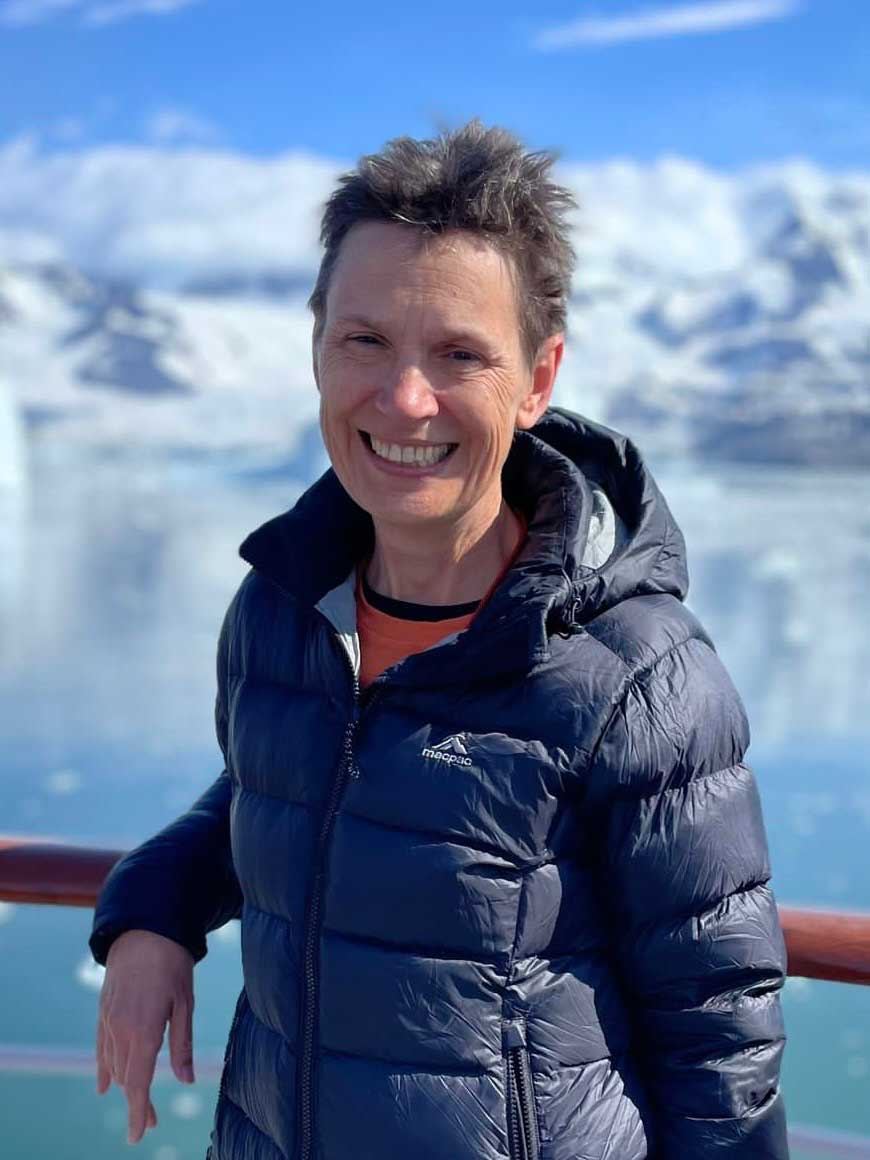
Elizabeth (Elle) Leane is Professor of Antarctic Studies in the School of Humanities, College of Arts, Law and Education at the University of Tasmania.
With degrees in both science and literature, she is interested in building bridges between disciplines, and particularly in bringing the insights of the humanities to the study of the Antarctic.
Elle examines how people form their ideas of Antarctica through both cultural texts and lived experience of the environment, and how these two ways of knowing the region interact. She has visited Antarctica as a writer-in-resident, an educator and a researcher, with the Australian, New Zealand and Chilean national programs. She currently co-leads (with Katie Marx) the Public Engagement with Antarctic Research Action Group within the international Scientific Committee on Antarctic Research. She is Arts and Literature Editor of The Polar Journal. Her books include Antarctica in Fiction and South Pole: Nature and Culture and the co-edited collections Anthropocene Antarctica and Performing Ice.
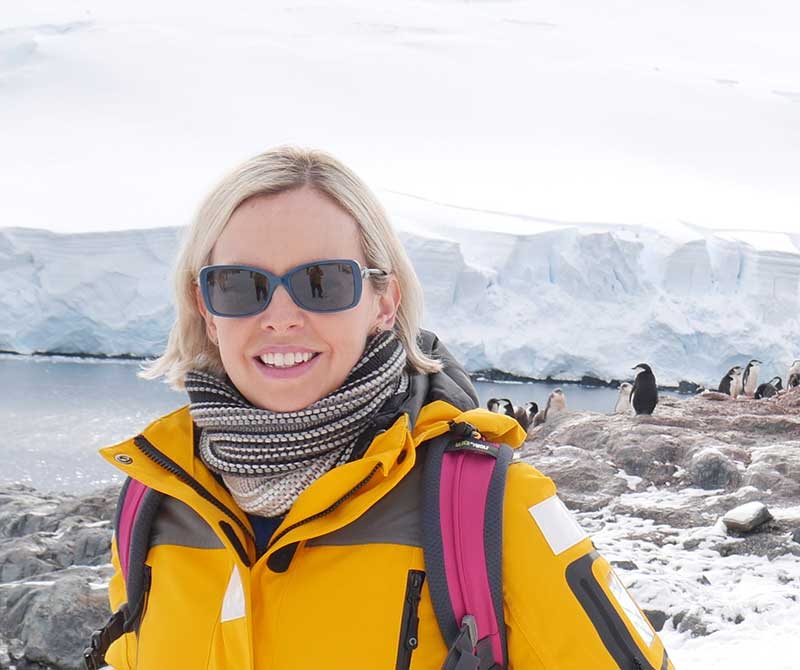
Dr Carolyn Philpott is a Senior Lecturer in Musicology at the University of Tasmania’s Conservatorium of Music and an Adjunct Senior Researcher at the University’s Institute for Marine and Antarctic Studies (IMAS).
Her research interests include Australian music and intersections between music, sound, place and the environment, especially music composed in connection with Antarctica.
Carolyn has published numerous articles and book chapters on music and soundscape-based compositions produced in connection with Antarctica, including in highly ranked musicology, historical studies and polar studies journals. She has conducted field work in Antarctica multiple times, focusing on the role of sound, silence and the senses in visitors’ experiences of the continent. She has presented her Antarctic-related research in the UK, Europe, the US, South America, Asia, Australia and on ships visiting Antarctica.
Her co-edited collection Performing Ice (with Professor Elizabeth Leane, University of Tasmania, and Professor Matt Delbridge, Deakin University) was published as part of Palgrave Macmillan’s Performing Landscapes series in 2020. She is currently a Chief Investigator on two Australian Research Council-funded projects, Creative Antarctica and Transforming Tourists’ Antarctic Experience.
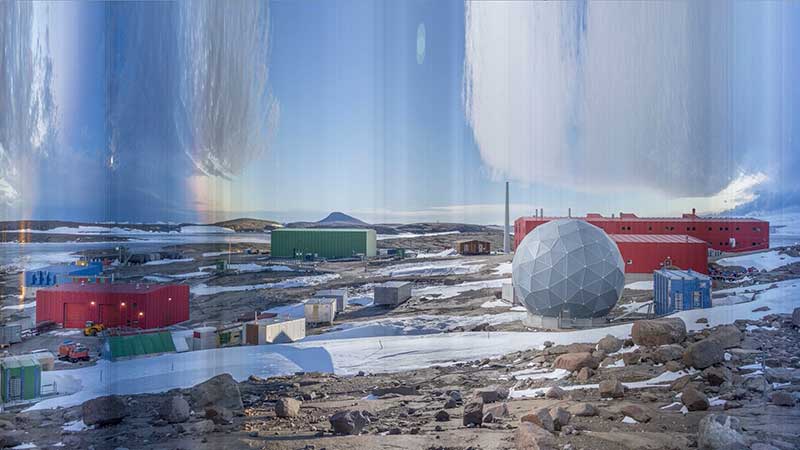
Dr Martin Walch is a Tasmanian artist who lives and works in Hobart, where he coordinates the Photography program at the School of Creative Arts and Media, University of Tasmania.
He works across a range of media including photography, video, sound, computer programming and data visualisation.
Martin was awarded the 2017/18 Australian Antarctic Arts Fellowship, and spent the austral summer at Mawson Station in East Antarctica, where he created compelling visual representations of human activity and environmental change in the Antarctic.
His work has been exhibited in national and international venues including;
- Photographica Australis Asia Tour;
- Naarden Photo Festival Nederlands;
- ARCO Madrid;
- the 2002 Adelaide Biennial of Australian Art;
- the Embassy of Australia, Washington DC, USA; and
- the Museum of Contemporary Art, Taipei.
Martin is represented in public and private collections including;
- the Tasmanian Museum and Art Gallery,
- the Australian Centre for the Moving Image,
- the Art Gallery of South Australia,
- Parliament House Art Collection, Canberra,
- The National Portrait Gallery of Australia, and
- the Nevada Museum’s Centre for Art and Environment.
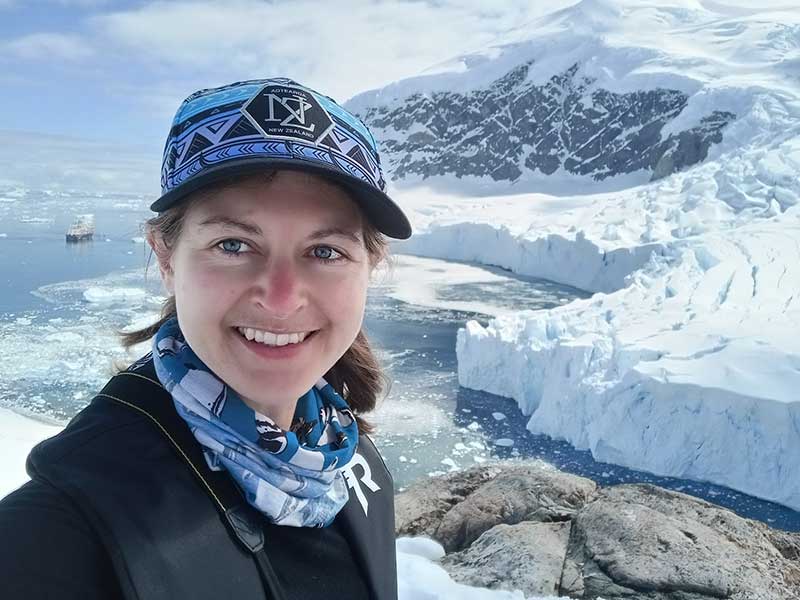
Dr Hanne Nielsen is a Senior Lecturer in Antarctic Law and Governance at the Institute for Marine and Antarctic Studies, University of Tasmania.
Her research focusses on representations of Antarctica in popular media, including in theatre and advertising material; polar tourism; and Antarctica as a workplace. Hanne was recognised as an emerging research leader as the first HASS-based researcher to be awarded a Scientific Committee on Antarctic Research (SCAR) Fellowship in 2017. She is a past President (2017–18) of the Association of Polar Early Career Scientists (APECS) and currently serves as Chief Officer of the SCAR Standing Committee on Humanities and Social Sciences (SC-HASS).
Having spent 5 seasons working as a tour guide in the Southern Ocean, Hanne has a particular interest in the contemporary practices of polar tourism as well as Antarctica as a workplace and has attended several Antarctic Treaty Consultative Meetings. She is the author of Brand Antarctica: How Global Consumer Culture Shapes our Perceptions of the Ice Continent (University of Nebraska Press, 2023).
In the classroom Hanne has taught across English, Governance, and Antarctic Studies, where she draws on real world governance examples of how science, policy, and cultural production intersect.
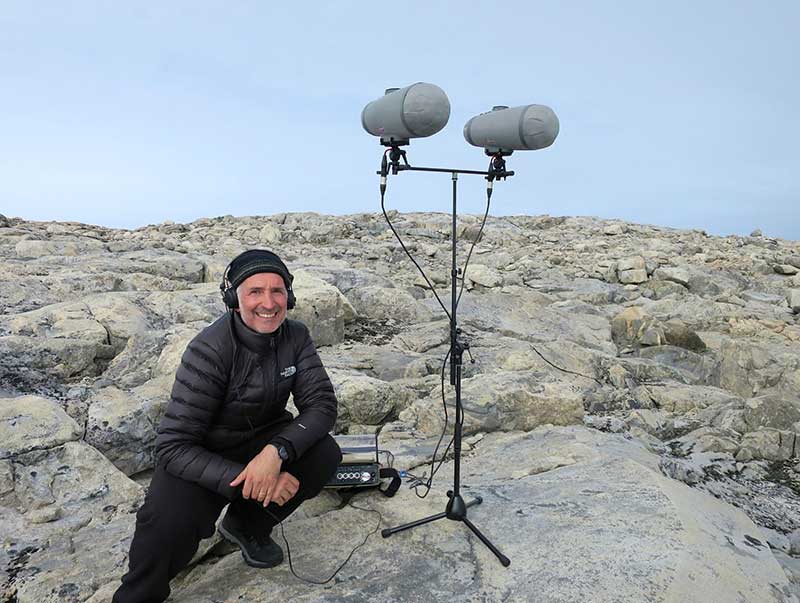
Professor Philip Samartzis is a sound artist, curator and researcher at RMIT University investigating the social and environmental conditions informing remote wilderness regions and their communities.
The sound recordings he makes deploying advanced audio technologies are used within teaching, exhibition, broadcast and publication to demonstrate the transformative effects of climate change within a contemporary art context.
Philip is a three-time recipient of the Australian Antarctic Territory Fellowship which he is using to document the effects of extreme climate and weather events. He is undertaking the most comprehensive sound study ever produced of the ice continent spanning 15 years.
Philip has presented various iterations of his practice led research in France, Switzerland, Italy, Japan, NZ, UK and US. Philip’s book Antarctica, An Absent Presence (2016) is included in curricula focusing on soundscape studies and geohumanities offered by London College of Communication, Musashino Art University, Durham University, the University of Syracuse, and the Zurich University of the Arts. In recognition of the innovation of his research, Philip was selected by Australia Post to appear on the $2.20 postage stamp commemorating the Australian Antarctic Territory Arts Fellowship.
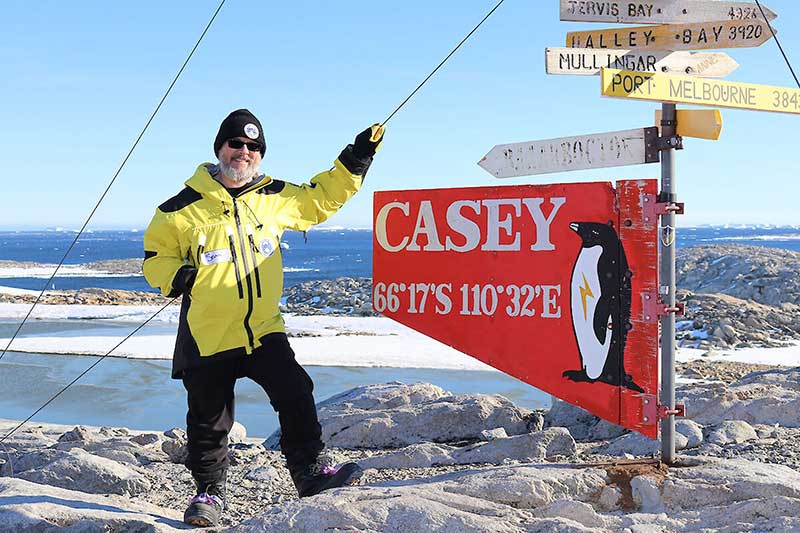
Dr Sean Williams is a #1 New York Times-bestselling, multi-award-winning author of over sixty books and one hundred and twenty shorter publications.
He is Discipline Lead of Creative Writing at Flinders University. In 2017, he visited Casey station through the Australian Antarctica Division’s Arts Fellowship, there to research an alternate history narrative combining the Heroic Age of exploration with War of the Worlds.
Since his return, he has published several works inspired by his expedition, ‘Last of the Rational Actors at the End of the Unnatural World’ in Griffith Review being the most recent in 2022. In addition to literary responses, his four-hour minimalist album Hyperaurea: Echoes of Antarctica was released in April from US label Projekt Records.
He composes experimental music under the name ‘theadelaidean’.
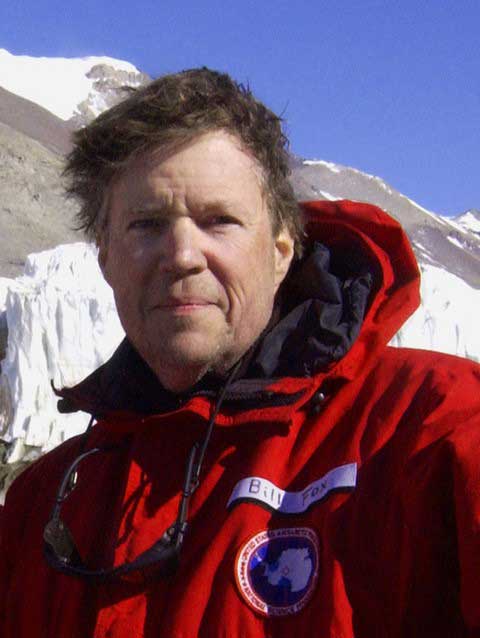
William (Bill) Fox is a writer whose work is a sustained inquiry into how human cognition transforms land into landscape.
His many nonfiction works rely upon fieldwork with artists and scientists in extreme environments. He is director of the Center for Art + Environment at the Nevada Museum of Art in Reno. Bill was born in San Diego and attended Claremont McKenna College.
He has edited several literary magazines and presses, among them the West Coast Poetry Review; worked as consulting editor for university presses; and directed the poetry program at the Squaw Valley Community of Writers. He has published poems, articles, reviews, and essays in more than seventy magazines and published sixteen nonfiction books exploring art, cognition and landscape.
In 2001–2002 he spent two-and-a-half months in Antarctica with the National Science Foundation, at the Antarctic Visiting Artists and Writers Program. He has been a Lannan Foundation writer-in-residence and received a Guggenheim Foundation fellowship. His latest book is Michael Heizer: The Once and Future Monuments.
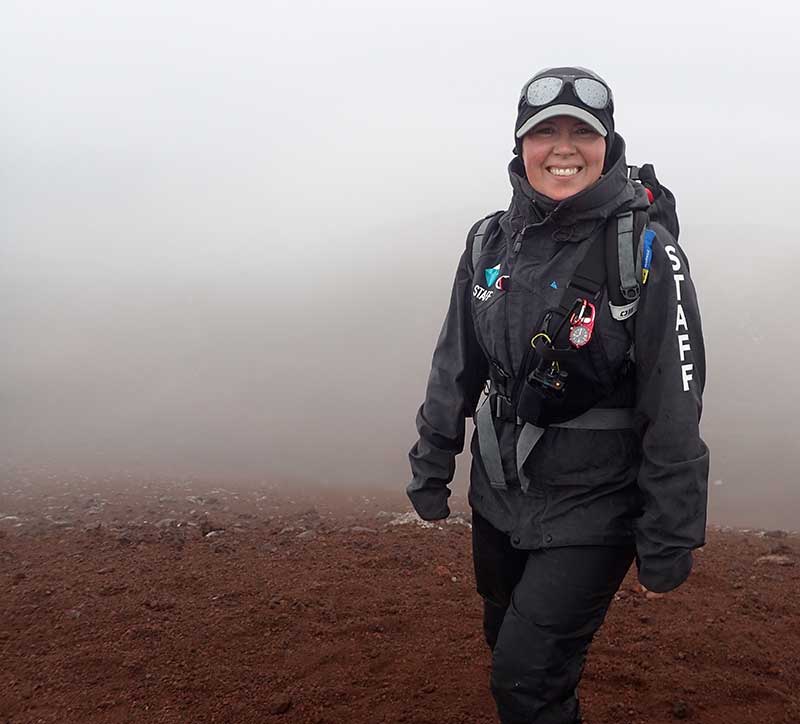
Dr Adele Jackson is an artist, curator and researcher interested in the interrelationships between nature and culture.
Adele is Curator Human History, with a specialism in Antarctic history, at Canterbury Museum, Aotearoa New Zealand. Her work investigates the role of art and material culture in developing understandings of the far south. Hosted at the University of Canterbury, Adele is an adjunct researcher with the University of Tasmania supporting the ARC-funded Creative Antarctica project.
She has worked in Antarctica in heritage and public engagement roles. Between 2014–2020 she led Antarctic Sun Lines, an arts-based collaboration with national Antarctic programs.
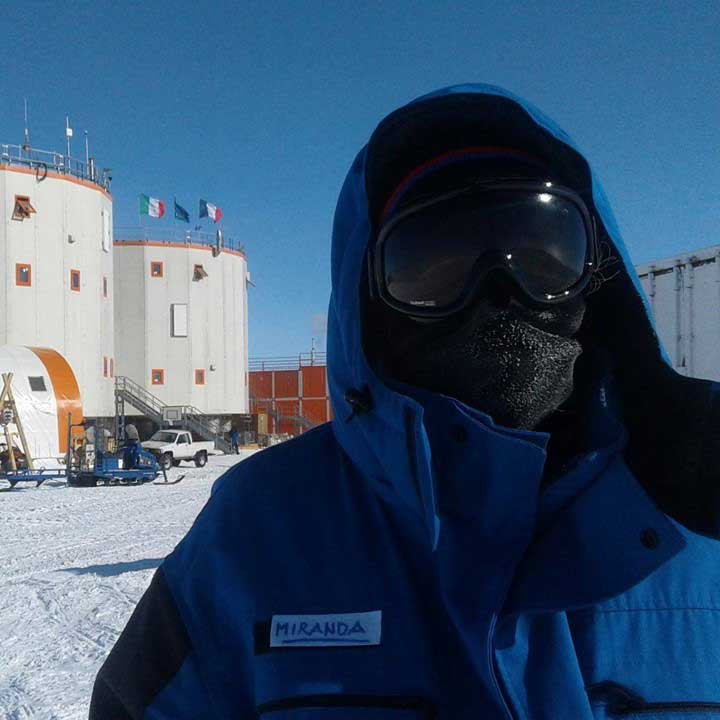
Dr Miranda Nieboer is an affiliated IMAS researcher in spatial and cultural studies with a background in Architecture and Building Engineering.
She has been researching, writing, exhibiting, and lecturing on human inhabitation in extreme environments for more than 20 years.
With an interdisciplinary approach, her research projects build bridges between different disciplines that investigate human relationships with glacial environments, especially the southernmost continent.
During her PhD research into Antarctic interiors, Miranda joined a logistical Antarctic traverse that enabled her to develop an embodied understanding of inhabiting the continent. Her work underlines the need for a further spatial and interdisciplinary consideration in Antarctic research.