BIO
Ganesh is currently pursuing a PhD in Environmental Engineering at the University of Tasmania. He holds a Bachelor of Engineering in Electrical and Electronics from Anna University, Chennai, and a Master of Science in Electrical Power Engineering from Khalifa University, UAE. His research interests include renewable energy integration and its impact on power systems, the environmental implications of renewable energy technologies, power system modelling, and the modelling of agri-food production systems.
PROJECT TITLE
Integration of Photovoltaics on Agricultural Land for On-Site Energy Generation and Optimisation of Crop Yield
SUPERVISORY TEAM
PROJECT SUMMARY
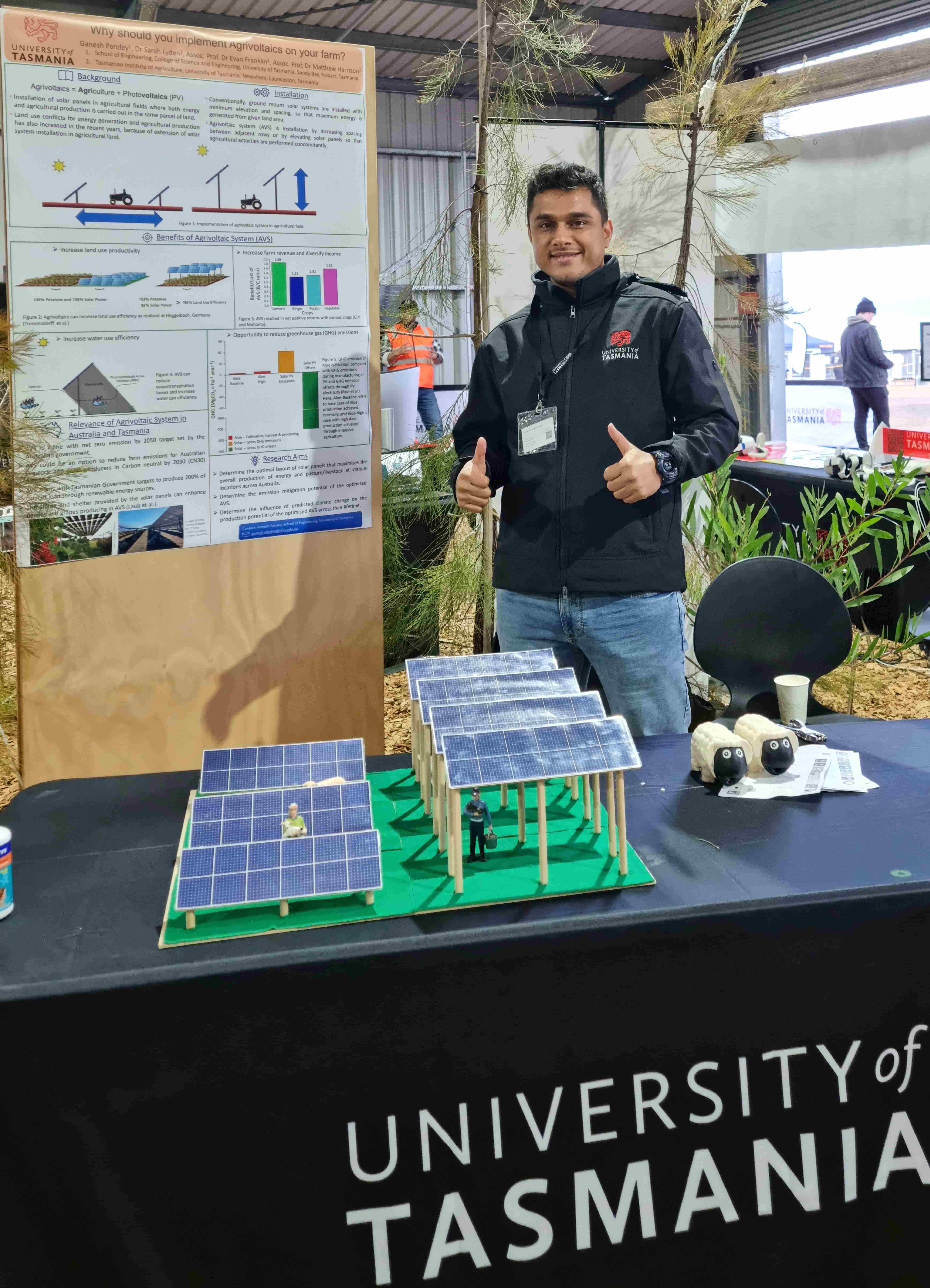
Agrivoltaic system (AVS) is an efficient land-use option that combine agricultural production and solar photovoltaic (PV) electricity generation on the same plot of land. This dual-use approach aims to address the growing global challenges of land scarcity, food security, and clean energy demand by enhancing overall land productivity. In conventional ground-mounted PV installations, solar panels are placed at a minimum height above the ground and spaced to maximize electricity generation efficiency. Vegetation is often removed to reduce shading and minimize maintenance costs. In contrast, agrivoltaic systems either widen the spacing between rows or elevate panels to allow intensive farming beneath or between the structures.
This PhD project aims at optimizing agri-food production and energy generation in AVS, therefore promoting actions to achieve sustainable development goals related to food and energy generation and consumption. This research also involves modelling the interaction between environmental factors—such as rainfall, temperature, and solar radiation—and system design and their impact on agri-food production and PV electricity generation. The outcomes will support the strategic design and implementation of AVS across diverse agroecological regions by enabling site-specific optimization of both energy and food production. Ultimately, this research aims to enhance the viability and adoption of AVS by demonstrating their potential to improve sustainability, productivity, and climate resilience.