

BIO
I, Alamgir Hossain, is currently pursuing a PhD in Electrical Engineering at the University of Tasmania, Australia, within the Centre for Renewable Energy and Power Systems (CREPS), under the supervision of Professor Michael Negnevitsky. My research directs on the design and control of offshore DC microgrids (MGs), aiming to develop robust control strategies that ensure system stability under diverse operating conditions. I completed both of my Bachelor’s and Master’s degrees in Electrical and Electronic Engineering from Dhaka University of Engineering & Technology (DUET), Bangladesh, where I am also serving as an Assistant Professor in the Department of EEE. I am a student member of the IEEE.
PROJECT TITLE
DC Microgrids for Offshore Applications
SUPERVISORY TEAM
PROJECT SUMMARY
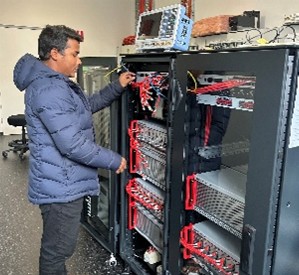
With the growing demand for sustainable and autonomous offshore operations, conventional energy solutions are no longer viable due to fuel logistics, emissions, and maintenance challenges. This research aims to develop a reliable and renewable-based DC microgrid (MG) to ensure clean, stable, reliable, and efficient power delivery in remote and harsh marine environments. The future of sustainable offshore operations depends heavily on reliable and efficient renewable energy-based power systems. This research addresses this need by developing a robust DC MG architecture tailored for offshore environments, integrating wave, wind, and solar energy alongside energy storage systems. This multi-source system enhances energy reliability and reduces dependence on conventional fossil fuel-based backup systems.
Most existing MGs are AC-coupled and often connected to the main grid, necessitating multiple stages of AC–DC and DC–AC conversion. This architecture introduces challenges such as frequency synchronisation, reactive power management, and voltage stabilisation. In contrast, integrating distributed renewable energy sources directly into a DC microgrid using high-efficiency DC–DC converters offers a more logical and potentially efficient solution. However, practical implementation remains challenging due to the limited commercial availability of suitable DC–DC converters that meet the performance and reliability requirements of such systems. A major challenge in such systems is maintaining DC bus voltage stability under rapidly fluctuating load and generation conditions. To overcome this, the proposed research develops a renewable energy-based offshore DC MG integrated with a robust control strategy to ensure stable and reliable power delivery to offshore platforms.
The outcomes of this research support the development of resilient, clean energy-powered offshore infrastructures such as fish farms, marine observatories, and ocean-based industries—advancing Australia’s Blue Economy and contributing to global carbon neutrality goals.