

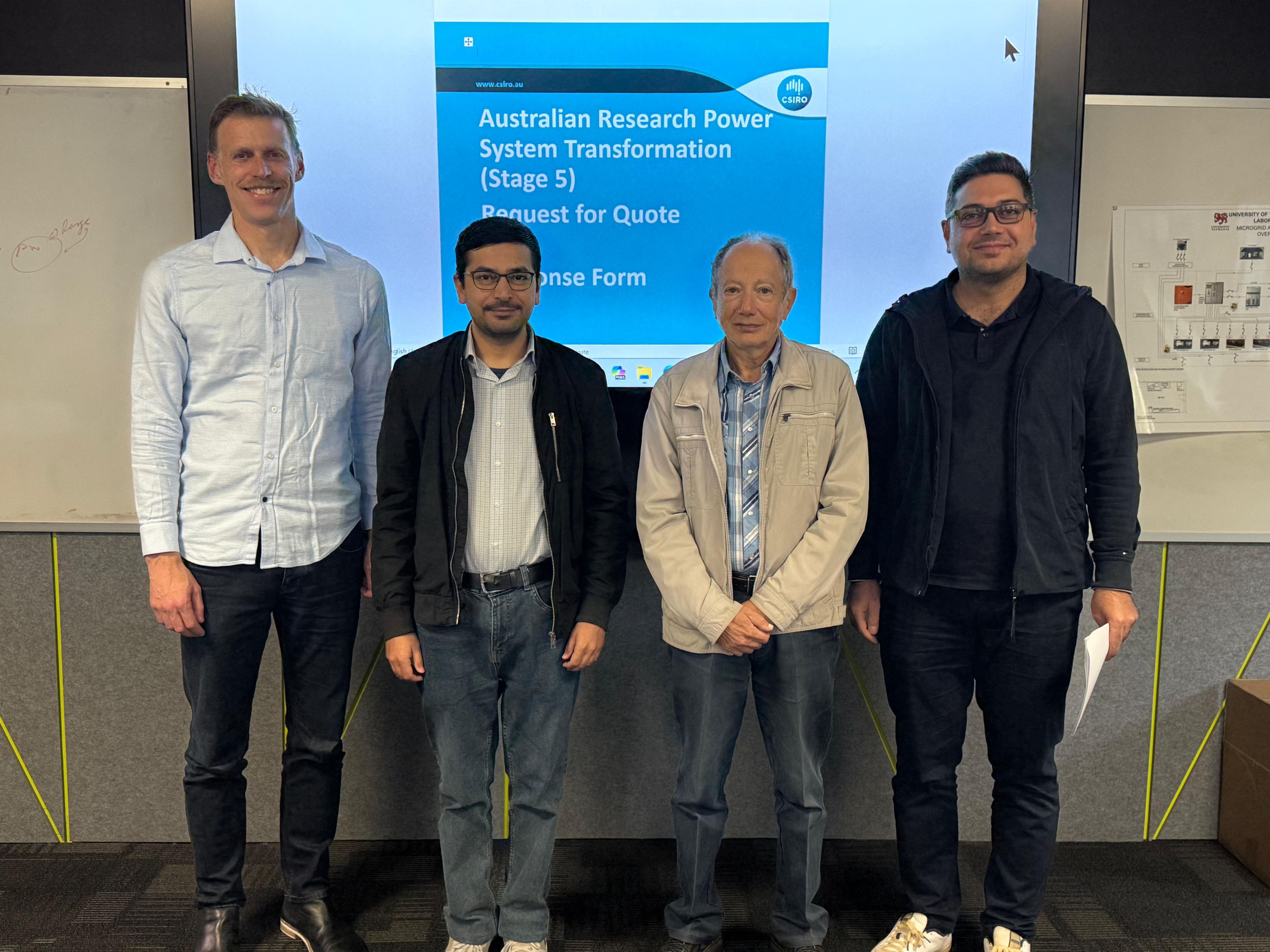
Exciting News: CREPS Team Awarded Grant for Power System Transformation Research
We are pleased to announce that our research team has been awarded funding under the CSIRO Australian Research Power System Transformation (Stage 5 – Topic 5: Blackouts and System Restoration) initiative.
The project is led by Prof. Michael Negnevitsky as the Lead Chief Investigator (CI), with Chief Investigators Assoc. Prof. Evan Franklin, Dr. Waqas Hassan, and Dr. Pooyan Alinaghi Hosseinabadi from the University of Tasmania (UTAS), Professor Mehdi Seyedmahmudian and Professor Saad Mekhilef from Swinburne University of Technology, and Professor Kashem Muttaqi from the University of Wollongong.
This one-year grant (2025–2026), valued at $398,000, supports research that aims to enhance the resilience and restoration capabilities of Australia’s power system following blackouts.
A special thanks goes to Dr. Pooyan Alinaghi Hosseinabadi for leading the preparation of an excellent proposal that contributed significantly to the success of this bid.
Further details about the project and its objectives are provided below.
DESCRIPTION:
Power systems are transitioning from conventional synchronous generation to renewable energy generation connected to the grid through inverters. Increasing penetration of inverter-based resources (IBRs) not only reduces grid inertia but also results in weaker grids. This increases the likelihood of blackouts, which may become inevitable especially in the transition period. To improve power system resilience, we need fast and robust restoration strategies. This proposal addresses these challenges by enhancing black-start capabilities explicitly under weak-grid scenarios within Australia’s National Electricity Market (NEM), with the aim of validating new methods and procedures experimentally using real-world data, realistic scenarios, advanced testbeds, and Hardware-in-the-Loop (HiL) methodologies. The project is designed to focus on both system current conditions and anticipated future scenarios within the NEM, ensuring adequate black-start readiness in response to blackout events. The outcomes will assist industry stakeholders, including AEMO, in establishing robust and adaptive procedures for system restoration following blackouts. These procedures will be developed for the evolving NEM, based on Integrated System Plan (ISP) scenarios, including those in which the system is fully powered by IBRs. The main objectives of our proposed research activities include assessing the self-start capability of Renewable Energy Zones (REZs) as System Restart Ancillary Service (SRAS) sources, evaluating the dynamic behaviour of critical system elements during restoration, developing innovative solutions that address both technical and regulatory requirements, and validating these solutions using testbeds and HiL platforms, alongside EMT dynamic simulations on realistic scenarios.