


Our oceans perform a vital role in absorbing atmospheric carbon dioxide, but rising levels of the greenhouse gas, combined with sea-surface warming and acidification are threatening this capacity.
Now, through the philanthropic Carbon to Sea Initiative, Associate Professor Lennart Bach is coordinating a global research project to understand if we can restore the carbon cycle sustainably.

Lennart is a marine biogeochemist at the Institute for Marine and Antarctic Studies (IMAS). He investigates the consequences of, and more importantly the solutions for, the climate crisis. In 2015 he attended the COP 21 meeting in Paris where the Paris Agreement was negotiated and the world agreed to limit global warming to between 1.5–2 degrees Celsius.
It was a great moment because policy was listening to the science. “But it also made me look more closely at what it would take to achieve this goal,” Lennart said. While everyone knows about “the Herculean efforts needed to phase out fossil fuel combustion”, fewer people were aware that political goals already included massive amounts of carbon dioxide removal in addition to emissions reduction.
“Looking at the numbers I was shocked back then, and still am today, that we are talking about needing to remove something in the order of 10 gigatonnes of carbon dioxide per year. That is one quarter of the current global carbon dioxide emissions,” he said. “Or, in other words, every fourth carbon dioxide molecule coming out of your car will have to be captured through yet unproven technology of the future; if that is the plan, then I thought it is definitely worth looking at the methods that shall deliver that.”
So, what is the relevance of ocean pH? The world’s oceans are estimated to absorb 25 per cent of the carbon dioxide from our atmosphere, making them the Earth’s largest ‘carbon sink’. However, with increasing atmospheric carbon dioxide and rising sea temperatures our oceans are becoming more acidic, which reduces their capacity to take up carbon dioxide. The result is that more of the greenhouse gas remains in the atmosphere.
It’s a feedback loop that is concerning scientists. Anyone who has ever owned a fishtank knows that a healthy pH is also essential for aquatic life. In the oceans, plankton, at the base of the marine food chain, are particularly susceptible. These tiny floating organisms have carbonate skeletons that dissolve when ocean acidity rises.
Of increasing interest to the world’s scientists, therefore, is whether there are ways of restoring the ocean’s pH balance so that marine life is protected and our seas are better able to function as vital carbon sinks and mitigate climate change.
Thanks to the philanthropic Carbon to Sea Initiative, which funds research dedicated to evaluating the ocean’s potential to mitigate climate change, Lennart established a global project to test how enhancing the alkalinity of seawater affects plankton.
Under the auspices of University of Tasmania Foundation USA, the project has seen Lennart coordinate research from Africa through Europe, Asia and Australia. Scientists at each location test the effects on local plankton of enhancing the alkalinity of seawater with material such as volcanic rock. Some have compared the approach to developing targeted antacids for our seas.
“Ocean Alkalinity Enhancement (OAE) is qualified as a novel carbon dioxide removal strategy but no one knows if it can work,” Lennart said. “Our research is among the earliest efforts to understand if we can restore the carbon cycle sustainably.”
Lennart says the idea is being investigated at the local scale in ways that are tailored to each region. The goal is to develop a simple, cost-effective protocol that is adopted globally so that the environmental safety and benefits of OAE can be assessed in a standardised and reproducible way. “I wanted to build community, bringing as many people interested in this topic together as possible,” Lennart said. “This is the topic of the moment.”
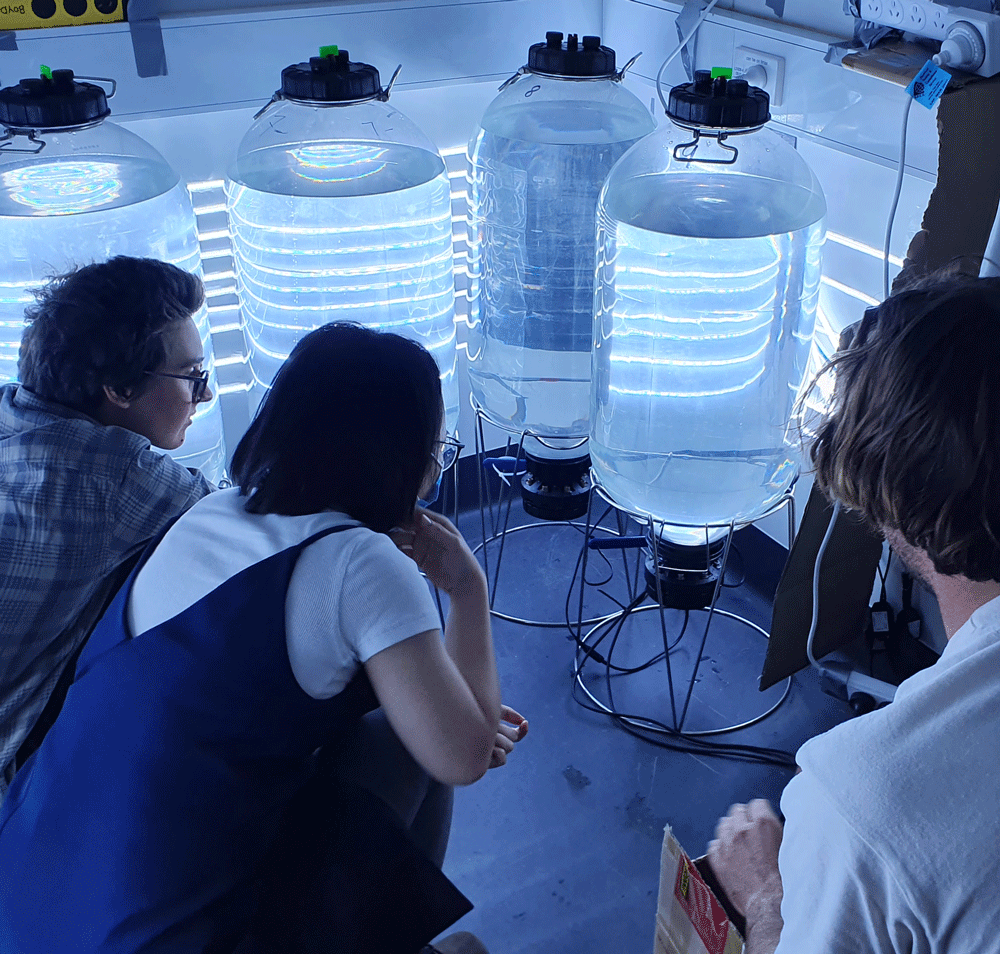
Each experimental tank, described as a microcosm, contains seawater and plankton, like a mini ocean community. “Everyone does the same experiments then sends the data to the University of Tasmania, which synthesises the results and looks for common overarching patterns. The aim is that we will hopefully understand if ocean alkalinity enhancement could make a contribution to mitigate the risks of climate change,” Lennart says.
The full name of the project is the Ocean Alkalinity Enhancement Pelagic Impact Intercomparison Project.
The Carbon to Sea Initiative is dedicated to evaluating the ocean’s potential to mitigate climate change. The work of our team, partners, and grantees is on the cutting edge of scientific exploration to determine whether and how OAE can deliver on its exciting potential.
Read more stories from Impact 2024
Learn more about Giving at the University of Tasmania